Beyond the CV: What If Understanding People Became Continuous?
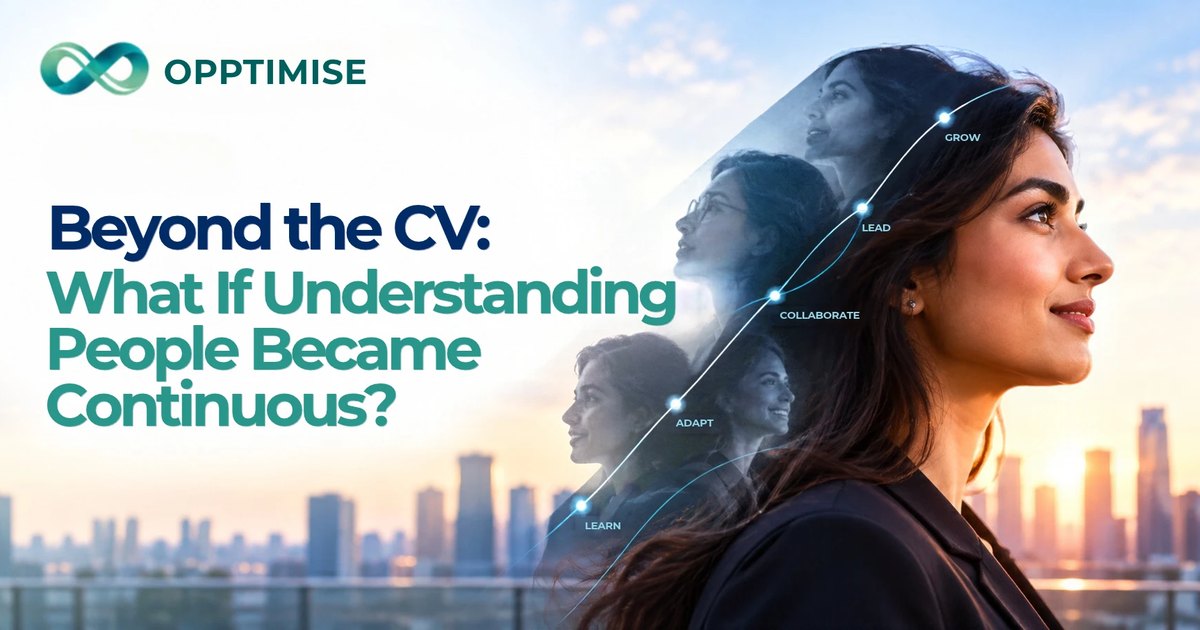
A CV, a hire, a review and a development plan each capture a moment. People keep changing between them. Here is what it means to understand people continuously.
Executive Takeaways
- A CV, an interview, a review and a development plan each capture a single moment. People keep changing in between, but what we learned about them often stays fixed.
- Each stage hands its reading to the next, and nothing in that chain asks whether the reading is still true. That is how a person's file can drift so far from the person.
- Continuous understanding means the reading of a person stays current as their behaviour and context change. It doesn't mean more scoring. It's about understanding people, not watching them.
- Three habits to start: note when and where you learned something, ask what's changed before a review or a development plan, and ask the person.
The file still says day one
Imagine someone hired three years ago on the strength of a strong CV and a good interview. Their file still says what it said on day one.
In those three years they've changed teams twice, taken on work they had never done, and become the person others go to when something breaks. Nobody wrote that down, because no process asked.
That's the gap this article is about. Many processes build our understanding of people at moments, then treat it as if it holds between them.
The short version: a CV, an interview, a review and a development plan each capture a single moment. People keep changing in between, but what we learned about them often stays fixed. Make understanding continuous: note when you learned something, and revisit it as behaviour and context change.
Understanding happens at moments
Many people processes are built around a handful of moments: the CV, the hiring decision, the performance review, the development plan. Each is a reasonable way to learn about someone. Each also has the same limit. It's a snapshot.
In our guide to Behaviour Intelligence, we make the same point about scores, surveys and annual reviews. They tell you where someone was on a given day.
The stages aren't wrong. Each answers a real question at the time it's asked. The gap is between them.
What each stage captures, and what it misses
Here is how we read the progression.
The CV. A CV records what someone has done: roles, qualifications, experience. It's a useful record of the past. It says little about how they work day to day, and nothing about what they've learned since the last line was written.
Hiring. An interview or assessment gathers evidence on one day, in one setting. It's a fair attempt to see how someone might work. What it can't show is how they respond once the job, the team and the pressure are real.
Performance. A review captures results against goals over a period. It often misses the behaviour behind the results, and what changed around the person while they were produced. A performance signal can prompt a question. It can't answer one.
Development. A development plan captures the skills and goals agreed at one point. It doesn't tell you whether behaviour actually changed. It also can't see strengths that were never in the plan.
Growth. Growth shows up as outcomes: a promotion, a new role, a completed programme. Underneath is the path that led there, and how the person works now. That path is rarely recorded.
There is a second problem, and it matters most. Each stage hands its reading to the next. The CV shapes the interview. The interview shapes early expectations. Early expectations shape the review, and the review shapes the plan.
Nothing in that chain asks whether the reading is still true. That is how a person's file can drift so far from the person.
Go back to the person hired three years ago. Suppose their CV said "analyst", and their second team needed someone to bring colleagues along rather than to analyse. Imagine the review that year still scored them on analysis, and the development plan offered a modelling course. Each stage did its job. None of them saw that the job had changed.
People change between the moments
How much people change is a question with a partial answer.
Start with measurement. Keil and Cortina reviewed earlier longitudinal studies and found that the power of ability tests to predict task performance weakened over time. The deterioration was more widespread than previously suggested (Keil & Cortina, 2001).
Research on personality looks at change in people themselves. A meta-analysis of 92 longitudinal samples found that, on average, people become more socially dominant, more conscientious and more emotionally stable. The change was clearest between the ages of 20 and 40 (Roberts, Walton & Viechtbauer, 2006).
An updated meta-analysis of 276 samples found that cumulative changes were slightly smaller than earlier estimates (Bleidorn et al., 2022). It also found that emotional stability showed a larger, steadier rise than earlier work suggested.
This evidence covers groups of people over years. It doesn't show how quickly any one person changes, or whether anything changes within a review cycle.
Beyond those averages, people also learn, meet unfamiliar situations, and behave differently as their role, team and workload change. Behaviour is shaped by the person and the situation. When the situation moves, the behaviour can move with it.
What continuous understanding means, and what it doesn't
Continuous understanding means the reading of a person stays current as their behaviour and context change. It doesn't mean more scoring. It's about understanding people, not watching them.
Behaviour Intelligence is the framework we use. This is the definition we gave in our guide:
Behaviour Intelligence is the practice of understanding people's behaviour at work through observation, patterns over time and context, so that people decisions rest on understanding rather than assumption. It moves from behaviour to pattern to context to conversation before a decision is made.
Continuity is the same sequence, run again as things change. A new pattern prompts a question. It doesn't answer one, so the conversation stays central. Human Intelligence, the human ability to read people and context and use judgement, is what turns that understanding into a decision.
Where to start
You don't need new software to begin. Three habits will do.
Note when you learned it. When you record something about a person, add when and in what setting you learned it. An observation with a time and place is something to check again. One without them starts to look like a fact. Keep records you'd be comfortable showing the person they describe.
Ask what's changed. Before a review or a development plan, ask yourself what you know now that you didn't know at the last stage.
Ask the person. The best update on someone often comes from a conversation, not a record. Ask what has changed in their work, what they've started doing differently, and what they'd like you to know.
None of this asks you to collect more. It asks you to hold what you already know more loosely, and to say when you learned it.
If a file hasn't changed in a long while, is that because the person hasn't, or because nobody asked?
That is the thinking behind Opptimise. Opptimise Hire assesses candidates on how they actually work, not just their CV. Like the rest of the platform, it is powered by the same Behaviour Intelligence foundation.
Hiring is only the beginning of understanding people. Better understanding comes before better action.
Sources
- Roberts, B. W., Walton, K. E. & Viechtbauer, W. (2006). Patterns of mean-level change in personality traits across the life course: a meta-analysis of longitudinal studies. Psychological Bulletin, 132(1), 1-25. doi:10.1037/0033-2909.132.1.1; PubMed
- Bleidorn, W., Schwaba, T., Zheng, A., Hopwood, C. J., Sosa, S. S., Roberts, B. W. & Briley, D. A. (2022). Personality stability and change: A meta-analysis of longitudinal studies. Psychological Bulletin, 148, 588-619. doi:10.1037/bul0000365
- Keil, C. T. & Cortina, J. M. (2001). Degradation of validity over time: A test and extension of Ackerman's model. Psychological Bulletin, 127(5), 673-697. doi:10.1037/0033-2909.127.5.673
- Opptimise, Behaviour Intelligence: Understanding Behaviour Before Deciding What to Do.
- Opptimise Hire description: opptimise.com/solutions/hire, retrieved 2026-10-16.
Drafted and illustrated with AI assistance and reviewed by the Opptimise team.