
Observation vs Interpretation: How to Describe What You See Before You Explain It
Observation describes what happened; interpretation explains why. How to spot interpretation in your notes and rewrite it before a people conversation.
Picture a manager writing mid-year notes about a coordinator, Tomas. This is a hypothetical example. The notes read: "Disorganised. Doesn't take feedback well. Needs to be more of a team player."
Three sentences, and not one describes something anyone watched happen. Each is a conclusion. The manager wrote them quickly.
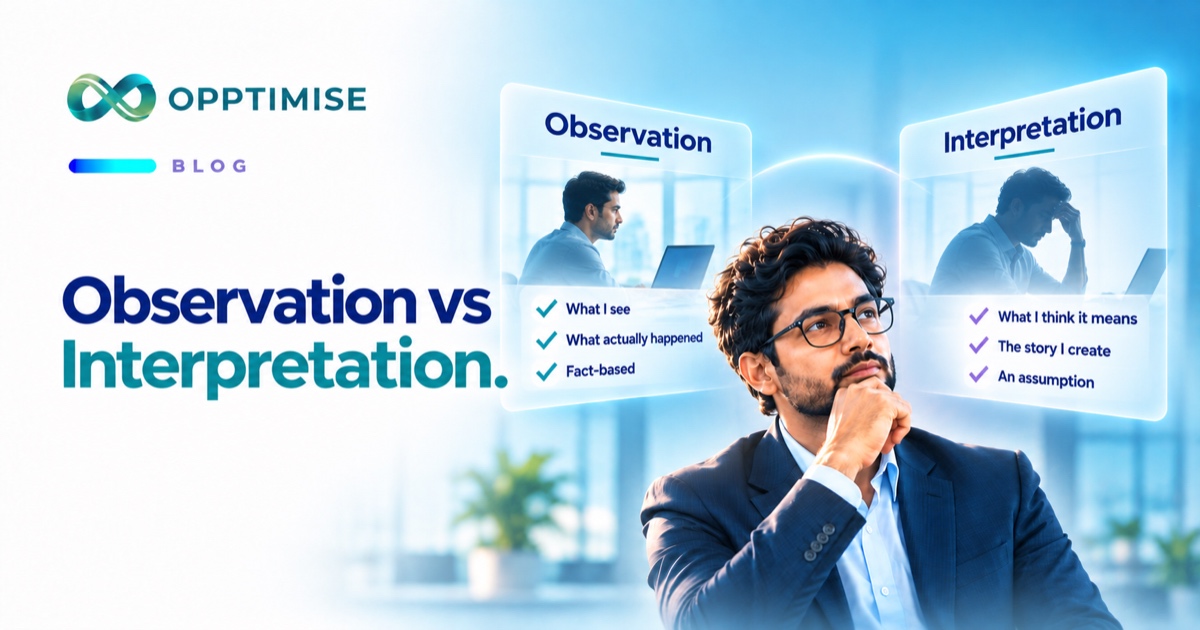
The short version: An observation describes what could be seen or recorded. An interpretation explains why it happened. They arrive together, so write the description first: who, what, when and how often. Then list possible explanations. If a camera couldn't have recorded your sentence, it contains a theory.
Why do the two blur together?
An observation is a description of something that could be seen or recorded. An interpretation is an explanation of why it happened, or what it says about the person.
Research suggests that inference can happen unprompted. Winter and Uleman gave people sentences describing actions that implied a trait. In recall tests, a trait word cued memory best, yet participants didn't report having inferred traits. The authors concluded that trait inferences can arise spontaneously (Winter & Uleman, 1984).
That was a laboratory study of sentences, not managers watching colleagues. It doesn't tell us how often you do it. It may suggest the blur isn't carelessness. A deliberate habit is worth trying.
There is also a research tradition on training raters. A quantitative review of rater training covered four strategies, one of them behavioural observation training (Woehr & Huffcutt, 1994). It doesn't tell us which strategy works best for managers' own notes.
Interpretation hides in four places
It rarely announces itself. In our working method, four places are worth checking in your own notes.
Trait words. "Disorganised", "defensive", "negative". Each sums up many moments and names none of them.
Verbs of intent. "Ignored", "avoided", "refused". These claim to know what the person meant. For example, "ignored my email" may be "didn't reply within five days".
Absences. "Didn't contribute" depends on where you expected a contribution. Record the occasion and the expectation, not the gap.
Quantity words. "Always", "never", "again", "often". Each hides a count you may not have made. "Late again" may rest on two late updates in a year.
Our working test is to ask whether a camera could have recorded it. "Raised his voice in the meeting" could be filmed. "Was aggressive" couldn't. If the sentence fails the camera test, rewrite it.
Our guide to Behaviour Intelligence gives a short test for this, and a table showing how one observation can carry several explanations.
Turn a note into an observation in four questions
Take each sentence and ask four things:
- Which occasion was it?
- How many times did it happen?
- How does it compare with this person's own earlier pattern?
- What would the sentence say if you removed the reason?
Here is the hypothetical note about Tomas, rewritten.
| The note | As an observation |
|---|---|
| Disorganised | Three of his last six weekly status updates reached the team after the Monday cut-off. The six before that were on time. |
| Doesn't take feedback well | In Tuesday's review I suggested a new template. He said "I'll look at that". It hasn't been used, and I haven't asked about it. |
| Needs to be more of a team player | He attended two of the last four planning sessions. In both, he left without taking an action, and attendees are expected to take one. |
Hypothetical example.
Each rewrite is longer than the note it replaced. Each also leaves a question open. That's the point.
Timing helps too. Jot the occasion down on the day, in a line. A note written weeks later may already carry the explanation you've formed since. Dated lines also give you the count and the comparison for free.
The rewrite reopens the explanations
The notes stop explaining Tomas and start describing a pattern. "Three of six late" invites a question that "disorganised" closed: what changed around the weeks when updates ran late? Perhaps the cut-off moved, or an input started arriving later.
The second row shows something else. The rewrite put the manager in the record: "I haven't asked about it." A trait word can hide your own part. A description makes it harder to hide.
From here you're building the picture, not finishing it. What Changed Around the Person? shows how to lay events beside the pattern. Performance Is a Signal. Not a Diagnosis. shows how to list explanations without picking one early.
Does a good description make you neutral?
No. You still choose what to notice. Why those six updates and not the six before? Why the planning sessions and not the other meetings? A description can be accurate and selective at once.
One check is to ask whether you'd have recorded the same detail about someone you rate highly. If not, your attention may be doing the work. This is the habit behind the fundamental attribution error: the person is in view, the situation isn't.
Write only what you'd be comfortable showing the person. Notes you couldn't share are often interpretation in disguise.
Questions you might have about writing notes
Do I need to do this for every note? No. Start with notes that feed a decision: a review, a development plan, a promotion case. Those are where a trait word can travel furthest.
Is "he seemed frustrated" an observation? Not quite. "Seemed" marks a guess about a feeling. Write what you saw: "He sighed and closed his laptop when the deadline moved."
What if I only have my memory? Say so in the note. "From memory, around March" is honest, and it tells the next reader how much weight the line can bear.
Say it out loud
An observation gives you a way into the conversation that doesn't accuse. "Three of the last six updates came in after Monday. I don't know why yet. How have those weeks looked from your side?"
That opening names what you saw and admits what you don't know. It also makes the first question easier to write: see Your First Question Is Already an Answer.
Then listen. The explanation may be one you listed, or one you hadn't thought of. Either way, you're now deciding on what you've understood, not what you assumed.
Opptimise helps people leaders keep what they saw separate from what they assume, so a conversation can start from what happened.
Describe first. Explain second. Better understanding comes before better action.
Sources
- Winter, L. & Uleman, J. S. (1984). When are social judgments made? Evidence for the spontaneousness of trait inferences. Journal of Personality and Social Psychology, 47(2), 237-252. doi:10.1037/0022-3514.47.2.237. Abstract confirmed via OpenAlex; full paper not read.
- Woehr, D. J. & Huffcutt, A. I. (1994). Rater training for performance appraisal: A quantitative review. Journal of Occupational and Organizational Psychology, 67(3), 189-205. doi:10.1111/j.2044-8325.1994.tb00562.x. Abstract confirmed via Crossref; effect sizes not read.
- Opptimise, Behaviour Intelligence: Understanding Behaviour Before Deciding What to Do.
Opptimise Editorial Team
Leading research and enterprise implementation in organizational psychology, executive development, and continuous Behaviour Intelligence.
Ready to Embed Behaviour Intelligence in Your Organisation?
Explore how Opptimise turns behavioural science into actionable daily coaching for your leaders and teams.
Related Insights & Next Reads
Acting Before You Understand: How to Choose a First Step You Can Take Back
You can't always wait for a full diagnosis. How to choose a small, reversible first step that helps you learn the cause as you act.
Halo and Recency: How One Impression Can Shape a Whole Review
Halo and recency effects can distort a performance review. How each works, and four checks to run against a dated record before you submit.
The Fundamental Attribution Error at Work: Why We Explain the Person and Miss the Situation
The fundamental attribution error explains behaviour through the person and underweights the situation. What it looks like at work, and what to check.